Showing posts with label Evaluation. Show all posts

Friday, 22 January 2016

Question 7


We evaluated our film opening and compared it to our Preliminary, and Juno tasks.
We spoke about how we used different angles compared to our Juno and preliminary. As you can see by the screenshots this is the extent of angles I used in my Juno, but I improved his massively in the film opening task.


Also I compared the film opening to my Preliminary task, where many of the shots were shaky due to the limited use of a tripod. Therefore in our film opening I ensured that we used a tripod, to make sure our shots were stable. But I also learnt how to stabilize shots in Adobe premier to ensure all of the footage looks as good as possible. As you can see from the screen shot our character isn't central in the shot, this was because we were filming this shot holding the camera. But also the cameraman is moving so the shot is very shaky, we made sure to eliminate any shots like this from our film opening.
Moreover I mentioned how my storyboards for both my preliminary task and my Juno task were quite rough and were not very detailed, so we ensured that we improved our storyboard for the film opening. As you can see in the first screen shot below, the storyboard for our preliminary task was very basic and therefore we struggled to film the shots we wanted. This then made me realise that to film successfully you need detailed and proper planning, therefore the next screenshot shows the storyboard for our film opening, it breaks down every individual shot, mentions timings and has a detailed description as to what will be happening in each shot. We also narrated over a video of our storyboard to ensure we included everything we wanted in our film cut.


All of these shots show a very varied of different angles in our film opening, which are much better than the angles I used in my Juno task and keep to the arty, cinematic feel of the documentary. This shows a clear improvement and shows that I thought about how I could improve the angles of shots I use to engage my audience more.

Lastly we spoke about how we decided to use a better camera than the media cameras. The Nikon DSLR we used made a much higher quality image for our movie and therefore made it look much better than my Preliminary and Juno task.

As you can see in this screenshot, we are both central to the camera, and the shot is very still and not shaky. This is because we used a tripod to stabilise the shot. Moreover you can see that the video quality of this shot is a lot higher than that of the preliminary task and Juno task, this is because, like I said, we used a better camera.


Wednesday, 20 January 2016

Question 5

How did you attract/address your audience?

Our target audience are intellectuals and like to watch documentaries so they would be use to having to listen along with visuals and in our case this is very poignant. Our visuals go along in an almost montage like state with the narration giving an intense blast to the senses of your eyes whilst you also listen to the narration going along with it. The visuals mise en scene go along with it very well: When in the narration it says the "latest glamour model" you see a model walking down a catwalk. the mise en scene linking to what is said in the narration. This carries on throughout the opening.

I think this constant change of scene will address our target audience because it is always changing, within the opening at least, and so it is working there intellectual minds. Making them think over and over, processing all these different images and settings.


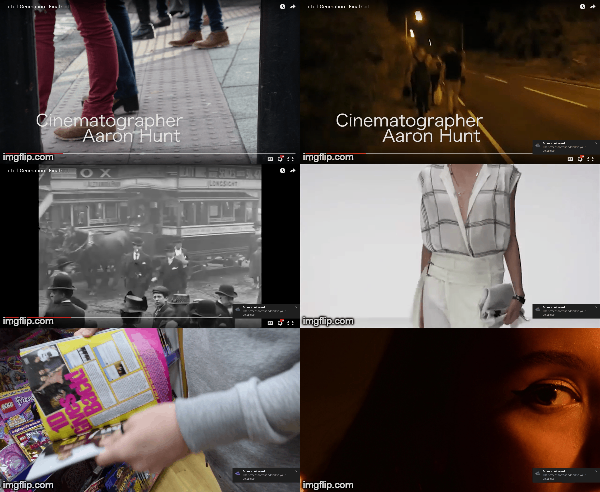
A few of the beginning shots from the opening sequence, showing the change in visuals that the watcher gets in the first c.15seconds.
Audience Viewing
We did a viewing of our opeing sequence to a small audience within our age range and recorded the answers to questions we asked them after they watched it, which is what is quoted below.


1. So before we entered the tattoo parlour, what did you think the documentary was about?
Matt - "Life and clothes."
Asel - "Culture and individuality."


2. And then when we entered the tattoo parlour and you started seeing all the mise-on-scene, did you make the connection, that it was about culture and expression through tattoos?
George - "Yeah, I saw it as a another way to express yourself, and individuality through tattoos."
Asel - "I definitely thought it was about culture and expression, with the tattoo artist and the parlour, but it took a while to get there, but that created good enigma."

3. Did you feel it created enigma around the topic of individualism and expression?
Toby - "Yeah, I thought it was quite good in that way, because it made me think 'What's going to come next?'"
Asel - "Yes, because you gave a little background to the individualism and didn't give too much away which kept me wanting to watch."


4. The problem we had was it was a documentary but we had to create enigma like a film opening would, do you feel that we did this effectively?
Toby - "Definitely because it felt like a documentary when watching, and included lots of documentary-esque shots, but also kept me hooked and didn't give too much away, just like an enigmatic movie opening."


5. Ultimately, would you go and watch it?
George - "I would definitely be interested in watching it, I feel that the movie appeals to people of our age, 16-17, and therefore reaches your target audience effectively."
Martyn - "I feel your marketing campaign would be very effective for people of our age, and like Matt said, this shows your film opening is effective at hitting your target audience. I would be interested in watching the film."

Audience we interviewed ---


Narrative theory

We used Barthes enigma codes to make our opening scene enigmatic, so it was not just like all documentaries telling you straight away what it was about but more like a film actually creating enigma, this caused the audience to ask question and try and make links with what they are seeing and hearing.
We used Levi Strauss in a sense of old opinion on tattoos vs the new opinion of tattoos. So not the classic way of Strauss (Good vs Evil etc) but still two things which are apparent and explored in the documentary.

We did not use Todorov because even though we had aspects like a film in the documentary it was not a film in every sense of the word so it did not have Equilibrium, Disruption of equilibrium, Restoration of Equilibrium, New Equilibrium. It just sifted through the idea, the question presented at the beginning of the doc.
We used Propp but not in the classic Hero, villain, dispatcher etc type of characters. Instead we would have the normal characters of a documentary the interviewer and the person being interviewed.

Thursday, 14 January 2016

Question 1


The Script Nathan followed in answering in the video


In what ways does your media product use, develop or challenge forms and conventions of real media products?

Our film, Tatted Generation, is a documentary for this we needed to research a few different films so we knew how to actually make a documentary film opening.
First we researched the codes and conventions of documentaries :

Narration - This is a common convention of the documentary genre with voice overs in a clear distinctive voice helping the narrative of the film and encouraging the watcher to listen and think.

Real Footage is another - All of our footage is "real footage" none of it is acted or re created for the film. Interviews and real places are really filmed they are not fictionally made up will be included which is a must with most documentaries.

We used archive footage ( so footage that is not ours maybe old maybe from our time) we used this for things we couldn't get like catwalks of models and old film footage.

Interview exerts were used to provide thought provoking opinion and information. And really a documentary doesn't feel like a documentary without interviews.

We used non-diegetic sound (so music) throughout the whole of the opening, maybe taken away for interview exerts, to add an ambience and atmosphere to the opening.

Visual Coding - the Mise en Scene of the whole opening sequence will add to the realness, hint at narrative and go along with narration. For example in the interviews the person being interviewed will maybe have tattoos or piercings or in the background there might be tattoo art on the walls etc..

These are codes and conventions commonly found in documentaries so we made sure have them in mind when planning and filming. We also looked at two films. McCullin and Ed Hardy : Tattoo the world. McCullin gave us an idea of using music to build the tension of the narrative and then also an idea of the titles, how they come in and the order. Ed Hardy gave us an idea of real footage that is used, archive footage and interview exerts with the shots and angles etc. but also a way of showing the story in a cinematic way that is pleasing to the eye.

To go through how these conventions and films influenced our end product I will go through 9 main shots/parts of the opening sequence.
1. The music starts whilst on a blank screen before any visuals so tension is being built, the music is easy to listen to and work very well in the background.
2. The narration begins at this point with the first few shots of our real footage
3. Then going into archive footage of old film and catwalk shots used to display our narration points.
4. Back to real footage, we filmed all over to get different shots for displaying the narrative of the documentary.
5. We used visual coding with what the viewer is seeing and what they are hearing like when we were talking about artists and creative we showed some art being painted and paint being mixed.
6. We dropped the complete narrative after enigma was created showing what the main question of the doc was about but still not being transparent about the full way of expression being about tattoos.
7. The cinematic shots of the tattoo parlor, using this mise en scene added more to the enigma and the narrative by the viewer maybe putting the pieces together by the doc being about expression through tattoos.
8. The simple title coming up, like most small documentaries have like that of Harry Hitchens Gay Sex Apps and more documentary fro Channel four.
9. Lastly the interview exert of a tattoo artist that we interviewed along with its cut away shots that kept interest in the interview by displaying different visuals to the watcher. As seen in Ed Hardy : Tattoo the world in their interviews.

Through using these conventions I feel like we hit the criteria of making a documentary like any other, conventionally speaking, using these classic traits made it easily recognizable as a doc and made it feel professional in the outcome, especially with the good quality image that we got from using my DSLR that I am filming this on but we also challenged classic documentaries and made our different. This is a media task after all and commonly documentaries aren't done so we had to make ours as much like film as it is a documentary. What I mean by this is in docs you normally know straight away what is happening and what they are about but in films there is a certain amount of enigma about what is happening. As having enigma was part of the criteria of marking we needed it so we had to in our opening style it like a doc using conventions but also create enigma we did this by not specifically saying the word tattoo till the interviews but linking to expression and culture and then mise en scene helped, commonly documentaries would not do this and through this I fell like our opening is like a blend of documentary and cinematic film.